If you’ve read that magnesium can help with sleep or stress, magnesium glycinate is usually the form people mean. It absorbs well, it’s easy on the stomach, and it has a reputation for calm that the other forms don’t. Here’s what it is, what it can and can’t do, and how to pick a good one.
Already decided? Skip to what to look for when buying, or see the glycinate I use myself.
What magnesium glycinate is
Magnesium glycinate is magnesium bound to glycine, an amino acid. Chemists call this pairing a chelate, and it matters for two reasons.
You’ll sometimes see the label say magnesium bisglycinate. For practical purposes, same thing.
What people use it for
Sleep. The headline use. Magnesium plays a role in the processes that help the nervous system settle, and glycinate’s profile makes it the form most people reach for at night. The trials are mixed: the best-studied benefit is falling asleep somewhat faster, and people who were low in magnesium to begin with are the most likely to notice anything.
Stress and winding down. Similar story. Plenty of people find an evening dose helps them feel a bit more settled. Where the effect exists, it’s gentle.
Sensitive stomachs. If citrate or oxide have upset your digestion, glycinate is the form most likely to sit well. This on its own is why a lot of people switch.
Dosing basics
Most people take it in the evening, which suits the sleep use. The number to read on the label is the elemental magnesium per serving, not the total compound weight; two products can look wildly different on the front and deliver the same usable dose.
Start low, see how you respond, and don’t exceed the suggested amount without professional advice. Taking too much announces itself as loose stools.
The usual cautions
The same three groups, on every page, because they matter every time. If your kidneys don’t work well, magnesium supplements can be risky, because the kidneys are what clear it: talk to a doctor first. If you take regular medication, magnesium interacts with several drugs, including some antibiotics, and a pharmacist can check yours in about a minute. If you’re pregnant or breastfeeding, ask your midwife or doctor before starting anything.
What to look for when buying
- Check the elemental magnesium per serving, not the headline number.
- Look for “glycinate” or “bisglycinate” stated plainly. Some cheaper products pad the formula with magnesium oxide to bump up the label figure. Legal if disclosed, but it’s not what you came for.
- A short ingredient list is a good sign.
- Third-party testing (an independent lab verifying what’s in the bottle) is a plus for any supplement.
Disclosure: the links below are affiliate links. If you buy through one I may earn a small commission, at no extra cost to you. It never changes what I recommend.
Sleep and stress
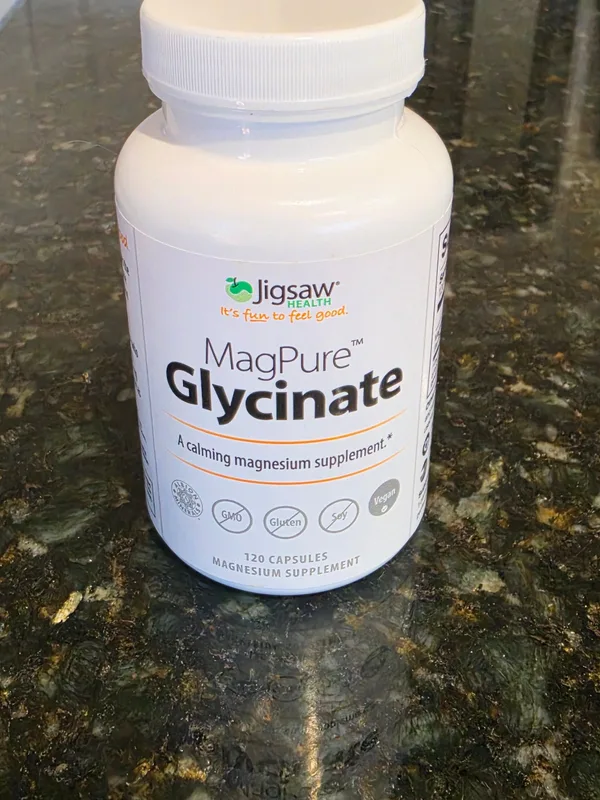
Jigsaw Health
MagPure Glycinate
The glycinate I take myself, about an hour before bed. Albion bisglycinate chelate, and the ingredient list is just the capsule and an anti-caking agent.
- Elemental magnesium50 mg per capsule
- PriceUS$29.97 for 120 capsules (roughly A$42 a bottle, about A36c a day)
Australian dollar figures are approximate, converted at US$1 = A$1.42 (checked August 2026), and exclude international postage.
Is glycinate better than citrate? Different jobs. For sleep, stress, and sensitive stomachs, most people prefer glycinate. For occasional constipation, citrate’s laxative lean is the point.
Can I take it every day? Many people do, within the suggested dose. Check with a professional first if you have a health condition or take medication.
When should I take it? Evening is popular because of the sleep angle. There’s no hard rule.
Sources: NIH Office of Dietary Supplements: Magnesium Fact Sheet (https://ods.od.nih.gov/factsheets/Magnesium-HealthProfessional/); bioavailability of magnesium diglycinate vs magnesium oxide, Schuette et al., Journal of Parenteral and Enteral Nutrition, 1994 (https://pubmed.ncbi.nlm.nih.gov/7815675/); oral magnesium for insomnia in older adults, systematic review & meta-analysis, 2021 (https://www.ncbi.nlm.nih.gov/pmc/articles/PMC8053283/); glycine and subjective sleep quality, Yamadera et al., Sleep and Biological Rhythms, 2007 (https://onlinelibrary.wiley.com/doi/10.1111/j.1479-8425.2007.00262.x); effects of magnesium supplementation on subjective anxiety, systematic review, Boyle et al., Nutrients, 2017 (https://pmc.ncbi.nlm.nih.gov/articles/PMC5452159/)
This article is for general information and isn’t medical advice. Talk to a qualified health professional before starting a new supplement, especially if you have a health condition or take medication.